
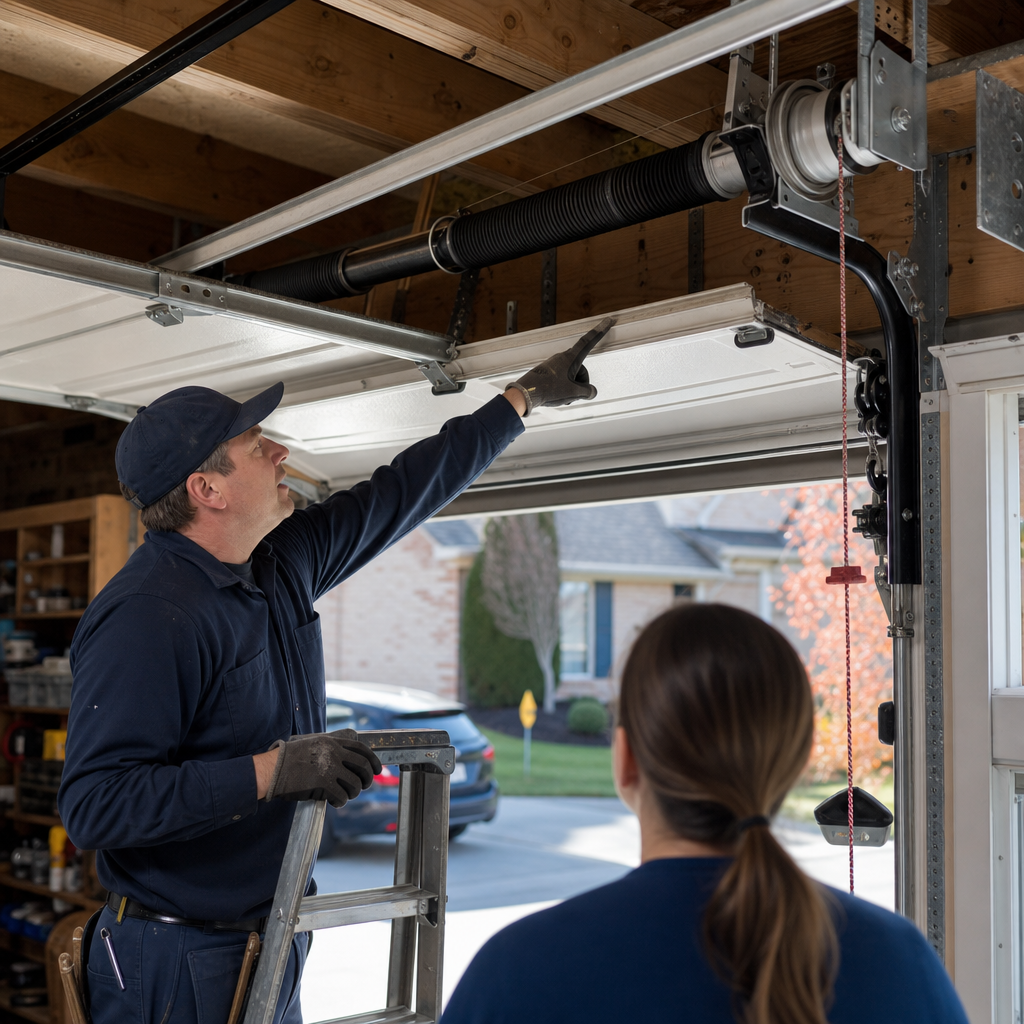
Why Does My Garage Door Reverse in Allentown, PA?
Your garage door reverses because the opener’s safety system detects what it thinks is an obstruction — most commonly in Allentown, a cold-weather force mismatch where the torsion spring loses tension as temperatures drop, making the door feel heavier to the opener and triggering the auto-reverse on a setting that was calibrated in warmer months. Nothing is actually blocking the door. The calibration is simply wrong for winter. If you’re stuck now, call Cardinal Garage Door Service Greater Allentown at (877) 730-7790 for Emergency Garage Door Repair in Allentown, PA — we recalibrate openers across the Lehigh Valley same-day.
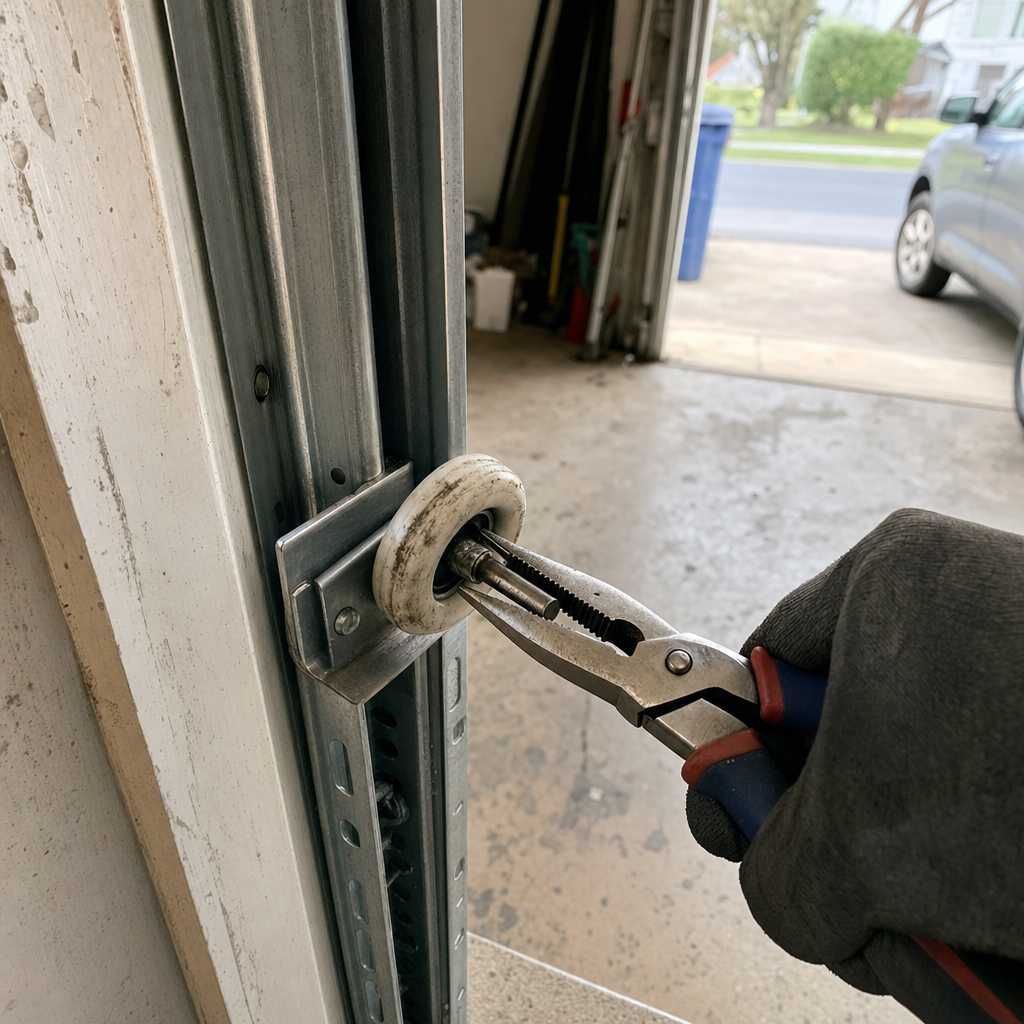
What Changed When the Cold Hit
Here’s the scenario we see dozens of times every January in Allentown: your door worked fine through October, started acting up in November, and by January it’s reversing two feet from the ground every single time you try to close it.
The mechanism is straightforward once you understand how the opener “feels” the door. Your opener doesn’t weigh the door directly — it measures the motor load required to pull it down. In summer, when your torsion springs are at full tension, the door is properly balanced and the motor cruises. When Lehigh Valley temperatures drop into the teens and single digits, those steel torsion springs contract slightly and lose effective tension. The door becomes heavier. The opener’s down-force setting, which was dialed in during 60°F weather, now interprets that extra resistance as something blocking the path — a child’s bike, a stray box — and reverses.
We’ve walked into garages in West End and the South Side where the homeowner has been living with this for weeks, assuming something is broken. Usually, nothing is broken. The door needs a seasonal force recalibration, and the spring tension should be checked while we’re at it. Stephen Rogers, our owner and lead technician, grew up a few blocks from Cedar Beach Park in Allentown’s West End and has been sorting out exactly this pattern for 14 years — it’s practically a Lehigh Valley winter tradition at this point.
This isn’t a DIY adjustment. The force and limit settings on modern openers are torque-calibrated, and adjusting them without knowing the door’s actual weight curve can disable the safety system entirely. We bring a scale and balance check to every recalibration call.
Allentown’s Alley Garages Make Sensor Issues Worse
Sensor misalignment gets all the attention in generic troubleshooting guides, but in Allentown’s dense pre-WWII neighborhoods — Old Allentown, the South Side, the row home wards — the real problem is where and how those sensors live.
These alley-accessed single-car garages, many built in the 1920s to 1940s, have low side rails and minimal clearance. The safety sensors sit close to the ground, sometimes barely four inches up, which means:
- Snow drift from alley plowing accumulates directly across the beam path
- Ice buildup on the threshold — common after Lehigh Valley overnight freeze events — reflects or blocks the infrared signal
- Salt and slush spray from alley traffic coats the lenses, scattering the beam
- Low headroom means sensors get bumped by storage items, ladders, or the door itself if the track flexes
The opener is doing exactly what it should: it sees an interruption and reverses. The issue is environmental, not mechanical. We carry replacement sensor brackets designed for low-clearance installs, and we’ll realign the beam path to account for your specific garage’s quirks.
Two brands we see constantly in this housing stock are older Craftsman and Chamberlain chain-drive units — many installed in the 2000s and still running. Their sensor systems are durable but finicky about alignment tolerance. A half-degree shift that wouldn’t matter in a suburban garage with 10-foot ceilings is enough to trigger random reversals in a tight Allentown alley garage.
The Limit Switch Problem on Aging Openers
Pre-2010 openers are everywhere in Allentown’s older homes, and there’s a specific failure mode that mimics an obstruction reverse but has a completely different cause.
The down-limit switch tells the opener where the floor is. Over years of cycling, cables stretch slightly, hinges wear, and the door settles lower in its travel. The opener still thinks “floor” is where it was programmed in 2008. The door reaches the actual ground, the motor keeps running for a split second against immovable resistance, and the force sensor reads that as an obstruction — reverse.
Homeowners often describe this as “the door closes all the way, then immediately bounces back up.” That’s your tell. The door isn’t hitting an object; it’s hitting the floor at the wrong point in the opener’s travel map.
We see this most on LiftMaster and Chamberlain units from the mid-2000s, which were overbuilt mechanically but use simple mechanical limit switches rather than the electronic position sensors in newer models. Resetting the limits requires running the door through its full travel while adjusting the switch cams — something that goes wrong frequently enough when attempted without the door properly balanced that we don’t recommend it as a homeowner project.
The One-Piece-to-Sectional Conversion Nobody Talks About
Some of Allentown’s oldest garages still had one-piece tilt-up doors until recently, and when homeowners convert to modern sectional doors, the opener settings almost never get re-profiled.
A one-piece door swings out and up in a single rigid plane. The resistance curve is front-loaded — hardest at the start, then the weight transfers to the horizontal tracks. A sectional door rolls through multiple hinge points, with resistance peaking at different angles and the overall weight distribution changing continuously. An opener calibrated for the one-piece curve will read the sectional’s mid-travel resistance spike as an obstruction, especially on the down cycle — a problem that often requires Garage Door Off Track Repair in Allentown, PA if the misalignment progresses.
We’ve been called to homes in the rowhouse wards where the door was converted five years ago and the reversal problem “just started” — meaning the original opener finally aged enough that its force tolerance tightened, or the springs degraded enough to push the mismatch over the edge. The fix isn’t a new opener. It’s reprogramming the force profile for the door that’s actually installed now.
What You Can Check Safely vs. What Needs a Tech
We’re not going to tell you to start adjusting force settings with a screwdriver. That’s how garage doors become garage door injuries. But there are two quick checks that cost nothing and tell us a lot when you call.
Safe self-checks:
- Wipe the sensor lenses with a dry cloth. Salt film and condensation scatter the infrared beam. If the LED indicators on both sensors glow steady (not blinking), alignment is probably fine.
- Test spring balance manually: Pull the red emergency release cord to disconnect the opener. Lift the door halfway by hand and let go. A properly balanced door stays put or drifts slowly. If it crashes down or rockets up, your spring tension is off — and that’s likely the root cause of your reversal problem.
Leave these to us:
- Force setting recalibration — requires knowing the door’s actual weight and the opener’s torque curve
- Limit switch adjustment — requires running the full travel cycle with proper safety positioning
If the manual balance test shows a heavy door, or if wiping the sensors doesn’t stop the reversals, the problem is in the calibration layer — and that’s where 14 years of focused experience matters. We’ve adjusted more Raynor and Genie openers in low-headroom Allentown garages than we can count, and we know the factory specs versus the real-world settings that work in these structures.
What This Costs to Fix in Allentown
Most reversal issues fall into one of three our Garage Door Repair services categories. Here’s what Allentown homeowners typically pay:
| Service | Typical Range |
|---|---|
| Opener force/limit recalibration | $120–$320 |
| Sensor realignment or replacement | $120–$240 |
| Torsion spring tension adjustment or replacement | $180–$340 |
| Full opener replacement (if unit is pre-2010 and failing) | $250–$550 |
We don’t charge diagnostic fees when you proceed with the repair — the assessment is built into the job. And we’ll tell you honestly if your 2005 Craftsman chain-drive is worth recalibrating or if you’re throwing good money at a unit with a stripped nylon gear waiting to fail next month.
When the Door Can’t Wait
A reversing door isn’t just annoying — in Allentown’s older neighborhoods, where alley garages often back directly onto rear entrances and ground-floor windows, a door stuck open is a security exposure. We’ve responded to emergency calls at 10 PM in January when a door that reversed at dinner won’t close at all, leaving the garage open to the alley overnight — exactly the kind of situation where Best Garage Door Repair in Allentown, PA matters.
Our emergency garage door service covers Allentown and the full Lehigh Valley. Stephen shows up himself for the majority of calls, which means you get the decision-maker on-site, not a subcontractor figuring it out from a phone script. If the door’s giving you trouble, there’s a reason — let’s find it and fix it right.
FAQs
The most common cause in Allentown is a cold-weather force mismatch: your torsion spring loses tension as temperatures drop, the door feels heavier to the opener, and the down-force setting — calibrated in warmer weather — interprets that extra resistance as an obstruction. Sensor issues from snow, ice, or salt buildup on low-mounted sensors are the second most frequent cause in our alley-garage housing stock. Call (877) 730-7790 for a same-day assessment — estimates are free.
Repair is usually cheaper if the unit is under 12 years old and the issue is calibration or sensors — typically $120–$320. Replacement becomes the better value when the opener is pre-2010, has already been recalibrated multiple times, or shows mechanical wear like grinding gears or a sagging chain. We’ll give you a straight comparison after seeing the unit; there’s no pressure to choose either option.
You can safely clean sensor lenses and test spring balance manually, but do not adjust force or limit settings yourself — these control the safety system that prevents the door from closing on a person or pet, and incorrect calibration can disable that protection entirely. In Allentown’s older housing stock, the low-headroom geometry also creates pinch points that aren’t obvious if you haven’t worked on these specific structures before. For anything beyond basic cleaning, call a specialist.
Most reversal fixes in Allentown run $120–$340, depending on whether the issue is opener recalibration, sensor work, or spring adjustment. Full opener replacement ranges $250–$550 if the unit is beyond repair. We don’t charge separate diagnostic fees when you proceed with service. Call (877) 730-7790 for an exact quote on your specific door — estimates are free.
If you’d rather have it looked at, Cardinal Garage Door Service Greater Allentown offers a no-pressure assessment in Allentown — call (877) 730-7790.
Written by Stephen Rogers, Owner & Lead Technician at Cardinal Garage Door Service Greater Allentown, serving Allentown, PA.