
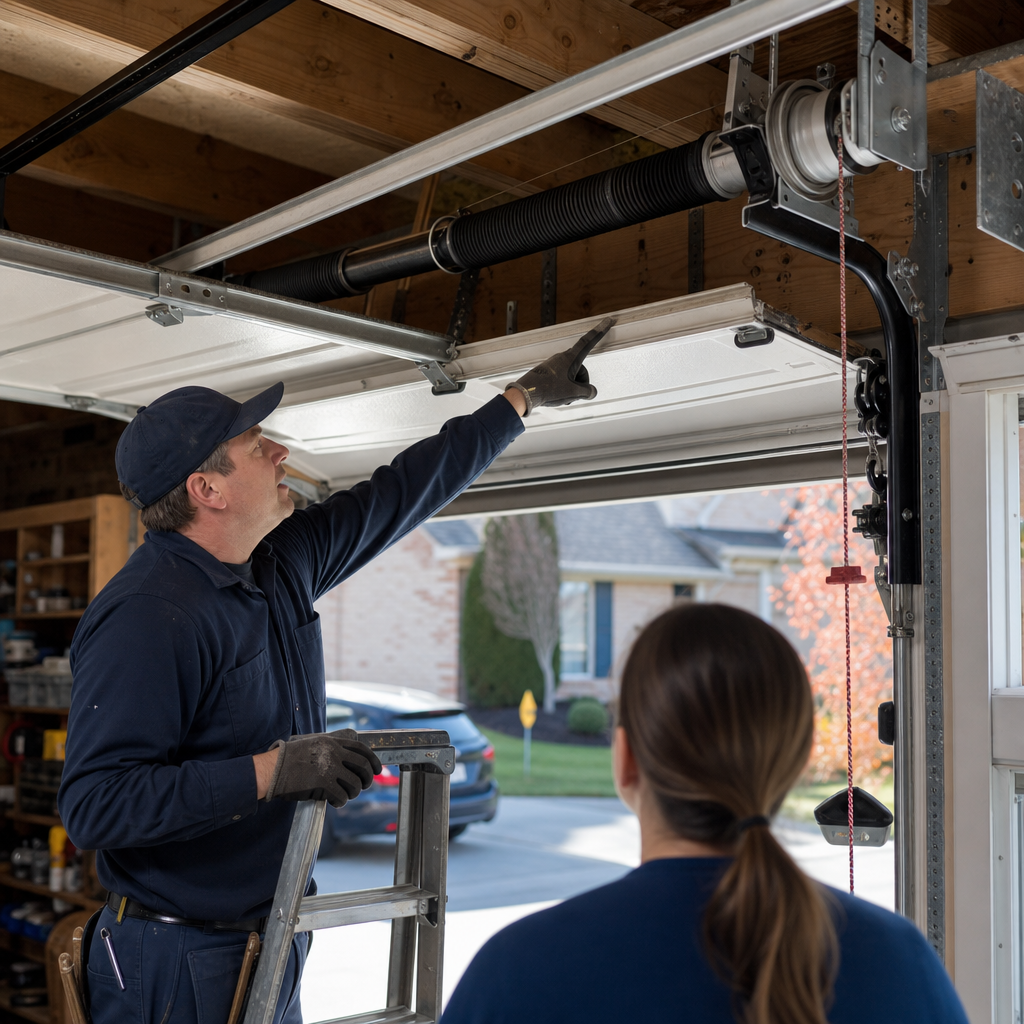
Why Your Garage Door Won’t Close in Allentown — And What Actually Fixes It
A garage door that won’t close in Allentown is most often caused by the bottom seal freezing to the threshold during Lehigh Valley winter nights, not a broken opener or misaligned sensor. If your door opens fine but reverses when trying to close and the opener light blinks, check for ice along the floor contact point before calling anyone — including us. When the problem isn’t weather-related, it’s usually dirty safety sensors, a failed logic board in older openers, or a remote that’s lost its pairing. For anything beyond ice removal or sensor cleaning, garage door repair in Allentown runs $150–$600 depending on what’s actually wrong, and we can diagnose it same-day — call (877) 730-7790.
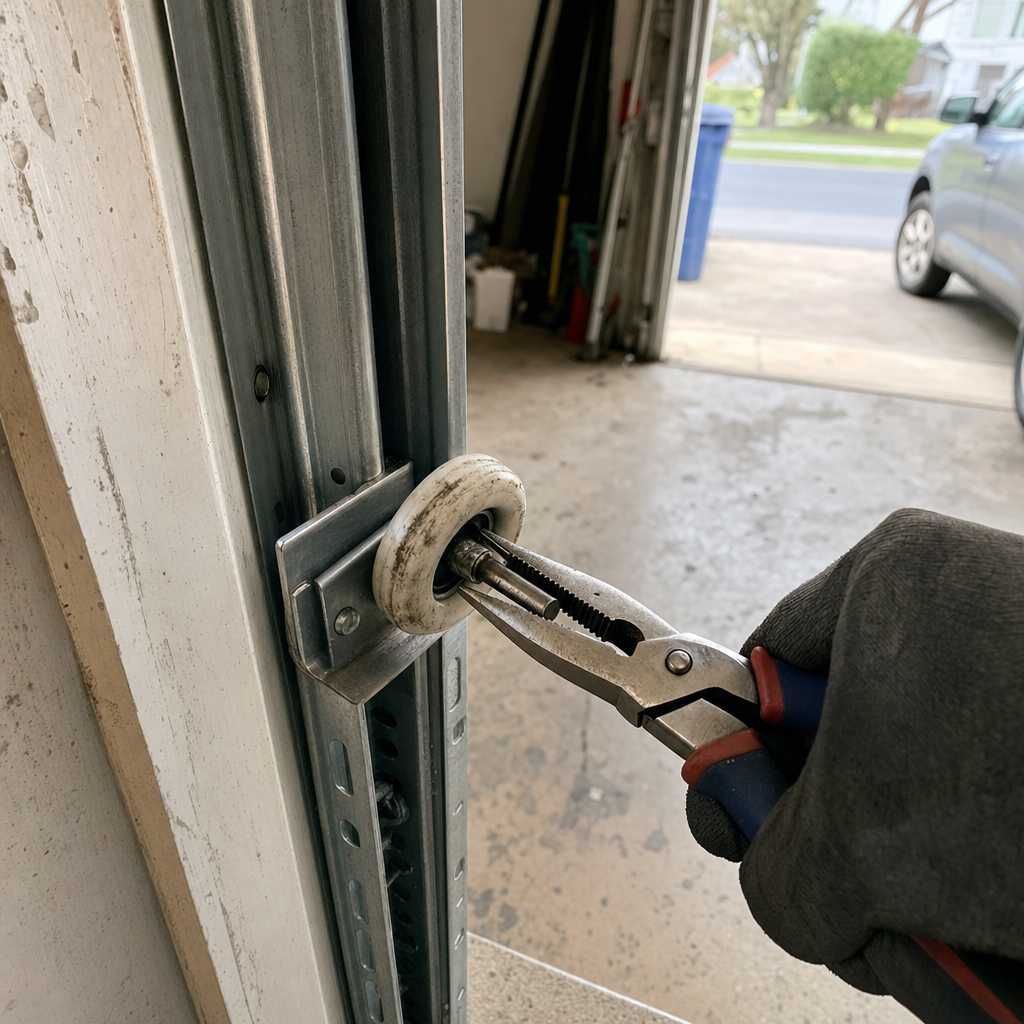
The Allentown Winter Problem Nobody Talks About: Ice-Bound Thresholds
Here’s what happens in our market that generic troubleshooting guides completely miss. Allentown’s late-winter pattern — wet days followed by nights below 20°F — creates a ridge of ice where your door’s bottom seal meets the concrete or asphalt. The opener’s safety system detects that resistance, assumes something’s blocking the door, and reverses. The light blinks. You think it’s broken. It’s not. The opener is doing exactly what it was designed to do.
We’ve seen this on dozens of calls across the West End, South Side, and Old Allentown neighborhoods, where alley-accessed garages from the 1920s and 1930s sit at grade level with no drainage slope. Water pools, freezes, and by 6 AM your door is glued shut from the outside. The fix is a heat gun or hair dryer on the threshold for five minutes, not a $200 service call. If you’ve got rock salt, spread it after you get the door down — it’ll prevent the next freeze.
This is worth saying clearly: if your door opens normally but won’t close on a cold morning, and the opener light blinks four times, try the threshold before you try anything else. We’ve had homeowners in Allentown’s row home alleys spend an hour cleaning sensors that were fine, while a half-inch ice ridge was the real culprit.
When It Actually Is the Sensors: What to Check Before You Call
If there’s no ice and the door still won’t close, the safety sensors are the next most likely cause. These are the small infrared eyes mounted 4–6 inches off the floor on either side of the door track. Here’s the diagnostic sequence we use ourselves:
- Check the LED lights. Both sensors should show a solid light — usually amber on the sending eye and green on the receiving eye. If either is blinking, off, or dim, they’re not talking to each other.
- Look for spider webs or mud dauber nests. Allentown’s older garages with open eaves and vented soffits attract both. We’ve pulled webs thick enough to block the beam entirely, especially in May and September.
- Verify nothing bumped them out of alignment. A bike handle, snow shovel, or kid’s hockey stick can knock one sensor crooked by just a few degrees. They don’t need to be perfectly parallel, but they need a clear line of sight.
- Clean the lenses. Road salt dust, cobwebs, or condensation film can scatter the infrared beam enough to trigger a false obstruction reading.
If both LEDs are solid and the door still reverses, the problem isn’t the sensors. Don’t keep adjusting them — you’ll waste an hour and possibly strip the adjustment screws.
Wall Button Works, Remote Doesn’t: The Frequency Problem
This diagnostic separates actual door problems from remote problems, and it saves homeowners a service call they don’t need. If the door closes fine from the wall button inside the garage but won’t respond to the remote or keypad, the door mechanism is healthy — the issue is signal.
Common causes in Allentown’s dense housing stock: LED light bulbs in the opener housing that emit radio frequency interference (certain brands are notorious for this), a remote with a dying battery that still has enough juice to light the LED but not enough to transmit a clean signal, or a keypad that’s lost its rolling code synchronization after a power outage. We’ve also seen remotes fail after being run through the washing machine — it happens more than you’d think.
Quick test: Stand inside the garage with the remote, 10 feet from the opener, with the garage door closed. If it works there but not from the driveway, interference or weak signal is likely. If it doesn’t work at all, replace the battery first. If that fails, the remote may need reprogramming — something we can walk you through by phone, or handle in five minutes if we’re already out.
The Aging Opener Problem: Logic Board Failures in 2008–2014 Units
Here’s a pattern we’ve tracked across hundreds of Allentown homes, particularly in the West End and South Side where original openers from the 2008–2014 era are still running. LiftMaster and Genie units from this period have known logic board vulnerabilities — capacitors that degrade, solder joints that crack from vibration, and firmware that glitches after power fluctuations.
The tell is specific: the door works sometimes, fails randomly, and the failure has no correlation to temperature, time of day, or sensor condition. You might close it successfully three times, then on the fourth attempt it reverses for no apparent reason with no blinking light pattern. Or the remote works intermittently while the wall button is reliable. These are classic logic board symptoms, not mechanical problems.
For garage door repair, logic board replacement runs $120–$320 in our market, depending on the opener model and whether the part is still manufactured. For units past 12–15 years, we typically recommend opener installation at $250–$550 instead — the new Chamberlain or LiftMaster belt-drive units are quieter, more efficient, and carry current safety standards that older boards don’t meet. Stephen Rogers, our owner and lead technician, keeps common logic boards in stock for the brands we service, but he’s straightforward about when replacement makes more sense than repair: “If I’m putting a $200 board into a 14-year-old chain-drive opener, I want the homeowner to understand they may call me again in two years for the motor.”
When the Door Closes by Hand But Not Under Power: The Force Setting Trap
This is where we need to be direct about safety. If your door moves freely and smoothly when you pull it down manually — disengaged from the opener — but reverses under motor power, the problem is almost certainly the opener’s down-force or travel limit settings. These control how much resistance the opener will accept before reversing, and where it thinks the floor is.
Do not attempt to adjust force settings without knowing your door’s actual weight and balance. A torsion-spring door that appears to move easily by hand may still weigh 150–250 pounds, and the opener’s force adjustment interacts directly with spring tension. Turning the force dial up to “make it close” without measuring door balance is how homeowners break springs, damage sections, or worse — override a safety system that’s trying to protect a child or pet. We’ve seen the aftermath in Allentown’s tighter alley garages where there’s no escape route if a door comes down hard.
The proper fix requires a door weight measurement, spring tension check, and calibrated force setting — typically a $150–$320 service call that includes full safety testing. If the door doesn’t move smoothly by hand either, you’ve got a mechanical problem — track damage, roller binding, or spring fatigue — that needs hands-on diagnosis.
What Garage Door Won’t Close Repairs Cost in Allentown
Pricing depends on what’s actually wrong, not a flat “service call” rate. Here’s what we charge for the most common repairs when a door won’t close:
| Repair Type | Typical Range in Allentown |
|---|---|
| Sensor realignment / cleaning | $120–$180 |
| Logic board replacement (opener repair) | $120–$320 |
| Remote reprogramming / keypad sync | $110–$150 |
| Force limit calibration with safety test | $150–$240 |
| Track realignment (if binding) | $120–$240 |
| Spring repair (if broken from force override) | $180–$340 |
| Full opener replacement | $250–$550 |
We don’t charge for the diagnostic if you proceed with the repair — and we’ll tell you honestly if the ice-thaw fix or a battery replacement solves it before we roll a truck. Cardinal Garage Door Service has built its reputation on not selling repairs that aren’t needed; with 619 verified reviews averaging 4.7 stars, that approach seems to be working.
The Allentown Housing Factor: Why Older Garages Complicate Everything
Allentown’s pre-1950 row home and twin home stock — dense in Old Allentown, the South Side, and much of the West End — creates garage door challenges that suburban technicians rarely see. Those narrow, alley-accessed single-car garages built in the 1920s–1940s often have sub-7-foot headroom, non-standard rough openings, and original wood frame conditions that were never designed for modern torsion-spring openers.
What this means for a “won’t close” call: the opener may be struggling because it’s the wrong type for the space — a standard trolley-rail installation where a wall-mount or jackshaft unit was needed, or an extension-spring conversion that added friction the opener can’t overcome. We’ve seen low-headroom hardware kits installed incorrectly by previous owners, creating binding that mimics a sensor or force problem. Stephen Rogers carries the specialized track brackets and low-clearance rails these Allentown garages require, because standard suburban inventory won’t fit.
The alley access itself is a logistical factor — our service truck navigates single-lane passages with no room to extend a ladder rack, and we’ve learned which alleys dead-end or have overhead utility lines that limit our lift options. It’s not a detail that matters to every customer, but it matters when you’re trying to get a door secured before nightfall in February.
FAQs
Most repairs run $150–$600, with sensor issues at the low end ($120–$180) and logic board or opener replacement toward the higher end ($250–$550). If it’s simply ice on the threshold, the fix costs nothing but your time with a hair dryer. Call (877) 730-7790 for a free estimate — we’ll ask a few questions and give you an honest range before scheduling.
Yes — we offer emergency garage door repair in Allentown, PA for doors stuck open or compromised, and we prioritize calls where the home’s security is affected. Same-day availability depends on call volume and parts needed, but we carry common sensors, logic boards, and remotes for LiftMaster, Chamberlain, and Genie units. When it can’t wait, we’re the call to make.
For openers under 10 years old, repair is usually cheaper — $120–$320 for a logic board or force calibration versus $250–$550 for replacement. For units over 12–15 years, replacement is typically the better value: newer belt-drive Chamberlain and LiftMaster models are quieter, more efficient, and include safety features like automatic reversal and timer-to-close that older units lack. We’ll give you both numbers and let you decide.
This almost always means the door and opener are mechanically sound — the problem is the remote’s signal. Check the battery first, then try reprogramming the remote to the opener. If it works inside the garage but not from the driveway, LED bulb interference or weak signal strength is likely. We can diagnose this over the phone in most cases, or handle it in minutes if we’re on-site.
When to Call Cardinal Garage Door Service Greater Allentown
If you’ve checked for ice, verified sensor lights are solid, tested the wall button versus remote, and the door still won’t close reliably — or if you’re not comfortable checking any of these — we’re here. Stephen Rogers shows up himself for the majority of calls, bringing 14 years of experience as the best garage door repair in Allentown, PA and working knowledge of LiftMaster, Chamberlain, Genie, Clopay, and the other major brands we service. Your brand, no problem. 619 neighbors have trusted us, and we built that reputation by fixing things right the first time.
If the door’s giving you trouble, there’s a reason — let’s find it and fix it right. Call (877) 730-7790 for a free, no-pressure assessment in Allentown.
Written by Stephen Rogers, Owner & Lead Technician at Cardinal Garage Door Service Greater Allentown, serving Allentown, PA.