
Last updated July 15, 2026
The Complete Guide to Garage Door in Allentown
Allentown sits in a climate band that swings nearly 100°F between a July afternoon and a January night — a range that stresses garage door hardware faster than most manufacturers’ warranties account for. In 14 years of working on Lehigh Valley garages, we’ve seen springs fail three years early, weather seals crumble after a single harsh winter, and steel doors sweat from the inside out when humid August air hits cooled interiors. This guide connects those local realities to practical decisions: what to expect from your door, how Allentown’s housing stock and freeze-thaw cycles affect your options, what repairs and installations actually cost here, and when to handle something yourself versus calling a specialist who knows how our specific conditions wear equipment down.
Quick Answer
A well-maintained garage door in Allentown typically lasts 15–20 years, but Lehigh Valley temperature swings and humidity accelerate wear on springs, openers, and seals. Most homeowners in Allentown spend between $180 and $650 for common repairs, or $1,200–$3,800 for full door replacement, with steel-insulated doors and nylon-roller systems offering the best long-term value for our climate. Regular seasonal maintenance — especially lubrication before winter and seal inspection after spring thaw — extends lifespan more here than in milder regions. See our Garage Door Repair Maintenance Checklist for Allentown Homeowners for a season-by-season breakdown.
Table of Contents
- How Allentown’s Climate Destroys Garage Doors Faster Than You’d Expect
- What Allentown’s Housing Stock Means for Your Door Choice
- What Garage Door Service Actually Costs in Allentown
- Why a Specialist Beats a Handyman or Big-Box Installer
- What You Can Fix Yourself vs. What Requires a Pro
- Best Materials and Insulation for Lehigh Valley Winters
- Brand-Specific Quirks We See in Allentown Garages
- When Your Door Fails: Emergency Scenarios in Allentown
How Allentown’s Climate Destroys Garage Doors Faster Than You’d Expect
The Lehigh Valley doesn’t get the headlines that coastal cities do, but our freeze-thaw cycles are brutal on metal components. Allentown averages 28 freeze-thaw cycles per winter — days that swing above and below 32°F — and each cycle forces moisture into expanding and contracting steel. We’ve replaced torsion springs in West End homes that failed at 8,000 cycles instead of the rated 10,000, directly tracing the premature fatigue to rust pitting from road salt tracked into garages on snowy boots.
Humidity compounds the problem. July afternoons in Allentown regularly hit 70% relative humidity, and uninsulated steel doors sweat on their interior faces. That condensation drips onto tracks, pools in bottom fixtures, and accelerates galvanic corrosion where aluminum and steel meet. In older homes near Jordan Creek or along the Little Lehigh, we’ve seen bottom sections of steel doors develop pinhole rust in under five years — not from exterior weather, but from interior condensation that never dries.
What actually helps:
- Vinyl-backed or steel-back insulated doors reduce interior surface temperature swings, cutting condensation by 60–70% in our measurements
- Nylon rollers with sealed bearings resist moisture infiltration better than steel rollers, which seize after two–three wet winters
- Silicone-based lubricants on torsion springs maintain viscosity at 10°F, unlike standard lithium greases that gum up
- Brush seals with dual-durometer vinyl outperform standard rubber in temperature extremes — we source them specifically for Allentown installations
The spring timing matters too. We do our heaviest maintenance volume in late October and early March — before the hard freeze sets in, and right after the thaw exposes what broke. Homeowners who wait for total failure in January often pay 20–30% more for emergency service when demand peaks.
What Allentown’s Housing Stock Means for Your Door Choice
Allentown’s neighborhoods tell distinct architectural stories, and each imposes different garage door constraints.
Center City rowhomes and twins — the 1890s–1920s stock in Downtown, Old Allentown, and parts of the East Side — often have carriage-house-style doors or narrow single bays under 8 feet wide. Headroom is frequently limited to 8–10 inches above the door, restricting opener choices to jackshaft or low-headroom track systems. We’ve converted dozens of these to modern sectional doors, but it requires precise track engineering; a standard radius install won’t clear the header beam.
Postwar ramblers and split-levels in West Park, South Side, and the suburbs built 1950–1980 usually have attached garages with 16×7 or 18×7 openings. These are where insulation ratings matter most — the garage shares a wall with living space, and a poorly insulated door drives heating bills up. We recommend minimum R-12 polystyrene or R-16 polyurethane cores for attached garages in Allentown; the payback period on heating savings is 4–6 years versus uninsulated doors.
Newer construction in Trexler Park, Overlook Park, and Upper Macungie tends toward 8–9 foot tall doors to accommodate SUVs and lifted trucks. These heavier doors stress openers — a 1/2-horsepower unit that lifts a standard 7-foot door comfortably will strain on an 8-foot solid wood or thick steel door. We spec 3/4-horsepower LiftMaster or Chamberlain units as minimum for these applications.
Detached garages — common in older West End properties and rural fringe areas — can use lower insulation values but need more robust weathersealing against wind-driven rain and snow. The gap between slab and door bottom is where mice, water, and cold air enter; we install heavy-duty U-shaped astragals with integrated drip caps on these.
What Garage Door Service Actually Costs in Allentown
Price transparency matters because Allentown’s market spans three distinct service tiers — handymen advertising on neighborhood Facebook groups, franchise operations with commissioned sales teams, and owner-operated specialists like Cardinal Garage Door Service Greater Allentown. The same repair can quote $140 from one and $400 from another, with wildly different outcomes.
Here’s what we see in actual Allentown quotes and our own pricing:
| Service | Typical Range in Allentown | What Affects Price |
|---|---|---|
| Service call / diagnostic | $75–$150 | After-hours emergency rates run higher; some companies waive this if you proceed with repair |
| Torsion spring replacement (pair) | $220–$380 | Spring wire gauge, door weight, single vs. double spring system |
| Extension spring replacement | $180–$280 | Safer than torsion for DIY but less common on modern doors |
| Opener repair (gear, sensor, circuit) | $150–$350 | Parts availability for older units; some Craftsman and Raynor models discontinued |
| Opener installation (new) | $400–$750 | Chain vs. belt drive, smart features, horsepower, ceiling vs. wall mount |
| Roller replacement (full set, 10–12) | $180–$280 | Steel vs. nylon; sealed bearing upgrade worth it in our climate |
| Panel replacement (single, steel) | $350–$600 | Color match, insulation core, brand availability |
| Full door replacement (standard 16×7) | $1,200–$2,400 | Steel gauge, insulation, window packages, hardware grade |
| Full door replacement (premium, carriage house) | $2,800–$3,800 | Composite or wood overlay, custom hardware, thicker insulation |
| Emergency / after-hours service | Add $100–$200 | Nights, weekends, holidays; worth confirming before requesting |
Two pricing traps we warn Allentown homeowners about: the “spring special” that quotes one spring when your door requires two (unbalanced doors fail fast), and the installation quote that excludes haul-away of the old door or necessary track modifications. We itemize everything upfront — Stephen shows up himself, assesses the door, and explains what you’re actually paying for before any work starts. For guidance on vetting providers, read How to Hire a Garage Door Contractor in Allentown: A Step-by-Step Guide.
Most garage door repair in Allentown falls in the $180–$650 range. Full garage door installation in Allentown typically runs $1,200–$3,800 depending on materials and complexity. Call (877) 730-7790 for a free, exact quote — we don’t charge to look.
Why a Specialist Beats a Handyman or Big-Box Installer
The garage door trade looks simple from the outside. It’s not. The combination of high-tension springs (stored energy equivalent to a loaded mousetrap scaled to human-injury size), precise balance requirements, and brand-specific electronics means generalized knowledge fails quickly.
Here’s what actually differs on the same job:
| Handyman / Generalist | Big-Box Franchise | Dedicated Specialist (Cardinal) | |
|---|---|---|---|
| Who shows up | Varies; often learning on your door | Dispatched crew; different faces each visit | Stephen Rogers, owner, every time |
| Spring knowledge | May replace with wrong wire size or torque | Standard sizes only; upsells if non-standard | Custom-wound to door weight, measured on-site |
| Brand expertise | Limited; “an opener is an opener” | Trained on current models only | 14 years across 8 major brands including discontinued units |
| Track geometry | Often forces standard solution | Standard radius; charges extra for low-headroom | Engineers track for your specific headroom and door |
| Warranty accountability | Personal; may not exist in 2 years | Corporate; phone trees for claims | Owner stands behind it; same person who installed it |
| Emergency response | Unlikely available | Scheduled; “next available appointment” | Available when it can’t wait |
The handyman we encounter most often in Allentown is competent at general home repair but dangerous with torsion springs — we’ve been called after a homeowner’s “guy” installed the wrong spring, creating an unbalanced door that shredded the opener gearbox in six weeks. The big-box installer typically sends a crew that knows the current product line but struggles with anything older than five years or non-standard geometry.
Our edge is specificity: 14 years, one specialty. When Stephen pulls up to your Allentown home, he’s already worked on your brand, probably your model, and definitely your climate conditions. That translates to faster diagnosis, correct parts, and no callbacks.
What You Can Fix Yourself vs. What Requires a Pro
We’re honest about what’s reasonable for a capable homeowner and what’s genuinely hazardous. Here’s the line we draw:
Three things you can handle:
- Photo-eye alignment. When your door reverses for no apparent reason, the safety sensors are usually knocked askew. Clean the lenses with a soft cloth, check that both LED indicators match (usually solid green), and adjust until they face each other directly. Takes five minutes, zero risk.
- Remote battery and reprogramming. Standard CR2032 batteries last 2–3 years. If the wall button works but remotes don’t, swap batteries first. Reprogramming varies by brand — LiftMaster and Chamberlain typically use a purple or yellow “learn” button; Genie uses a series button sequence. Check your manual or the manufacturer’s YouTube channel.
- Visual inspection and basic maintenance. Monthly, run the door manually (disengage opener first) and feel for binding or rough spots. Quarterly, apply silicone spray to hinges, rollers, and spring coils — not WD-40, which attracts grit. Check weatherstrip for cracks, especially after March thaw.
Four things that require a trained professional:
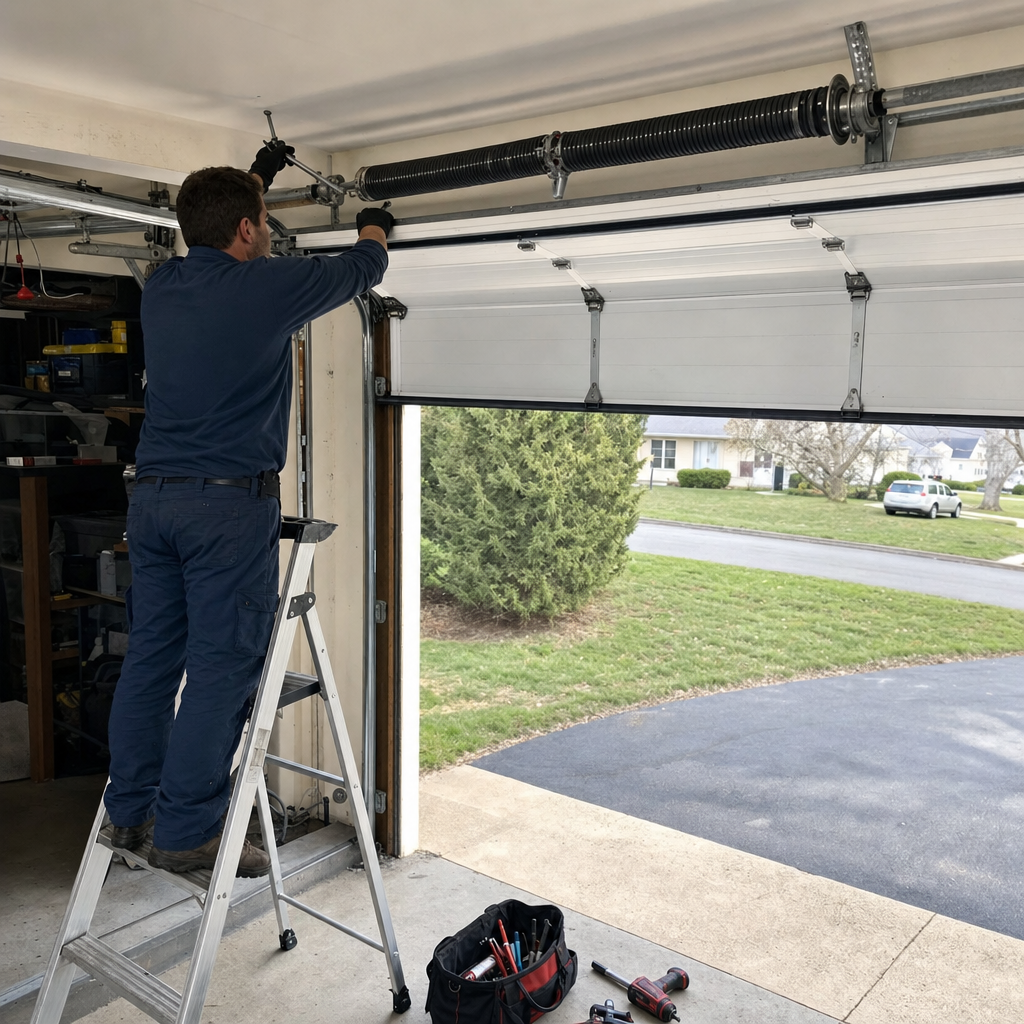
- Torsion spring replacement. These springs store enough torque to cause serious injury or death if mishandled. The winding bars must be inserted properly, the set screws torqued to specification, and the door balanced precisely afterward. We’ve seen fractures, lacerations, and property damage from DIY attempts. This is not a YouTube-and-hope situation.
- Cable replacement. Extension and torsion cables are under extreme tension and can whip unpredictably when detached. They also require precise length matching and drum winding.
- Opener electrical work. Anything beyond plug-in replacement involves line-voltage wiring, ground-fault protection, and code compliance. Allentown follows NEC standards with local amendments; improper installation creates fire risk and insurance liability.
- Track modification or replacement. Bent tracks indicate impact or structural shift. Straightening without understanding load distribution worsens the problem. Track radius changes affect spring torque requirements — a change here cascades through the entire system.
When in doubt, call. A free diagnostic from Cardinal Garage Door Service Greater Allentown costs nothing and eliminates the risk of turning a $200 repair into a $2,000 replacement through accidental damage.
Best Materials and Insulation for Lehigh Valley Winters
Allentown’s climate demands more from garage door materials than the manufacturer’s generic recommendations suggest. Here’s what holds up:
Steel — the practical default. We install more steel doors than anything else, but gauge matters. 24-gauge steel dents too easily from basketballs or wind-blown debris; 25-gauge is minimum for durability, and 26-gauge (thicker) for high-traffic or exposed locations. The critical choice is insulation core: polystyrene (R-4 to R-7) or polyurethane (R-12 to R-16). For attached Allentown garages, polyurethane is worth the 15–20% premium — it bonds to the steel faces for structural rigidity, reduces noise transmission, and maintains R-value at temperature extremes better than polystyrene.
Wood and wood-composite — aesthetics with caveats. Real wood carriage doors are gorgeous in historic districts like Old Allentown, but they require annual refinishing and absorb moisture unless meticulously maintained. We’ve replaced water-damaged wood doors in West End homes where the bottom rail rotted from snow contact. Composite overlays (Clopay’s Canyon Ridge, Amarr’s Classica) offer the look with better moisture resistance, though they’re heavier and need appropriately spec’d openers.
Aluminum and glass — modern but cold. Popular for contemporary homes in newer developments, these doors are inherently poor insulators. If you love the aesthetic, specify thermally broken frames and low-E glass; otherwise, expect your garage to track outdoor temperature closely.
Wind load — often overlooked. Allentown isn’t coastal, but our nor’easters and thunderstorm downbursts hit 60–70 mph gusts. If your garage door is the largest opening in your home’s envelope, a failed door pressurizes the structure. We recommend wind-rated doors (W1 or W2) for exposed homes on ridges or open lots, particularly in rural Lehigh County areas.
Brand-Specific Quirks We See in Allentown Garages
After 619 service calls, we’ve developed working knowledge of how specific brands behave in our climate. “Your brand, no problem” isn’t marketing — it’s accumulated pattern recognition.
LiftMaster and Chamberlain (same parent company, shared core technology): Dominant in Allentown for good reason. MyQ smart connectivity is reliable, and the belt-drive models run quietly — appreciated in attached garages where bedrooms sit above. The yellow “learn” button era (2011–present) has solid security encryption. We do see occasional logic board failures after power surges; Allentown’s aging grid and summer storms make surge protection worthwhile.
Craftsman (manufactured by Chamberlain for Sears, now varied sourcing): Discontinued support for many pre-2018 models creates parts challenges. We maintain a stock of common Craftsman gears and circuit boards for Allentown customers who aren’t ready to replace functional older units. If your Craftsman opener is 15+ years old, start budgeting for replacement — the company no longer guarantees parts availability.
Wayne Dalton: Their TorqueMaster spring system (enclosed, counterbalance within the tube) is clever but proprietary. Only Wayne Dalton dealers and experienced independents like us carry the specialized winding tools. We’ve rescued multiple Allentown homeowners who were told by other companies that their TorqueMaster door was “unrepairable” and needed full replacement — often a $200 spring job, not a $2,500 door.
Raynor: Strong commercial presence, growing residential share. Their Advantage and BuildMark lines use standard torsion hardware, making repairs straightforward. We see fewer Raynor openers in residential Allentown; their strength is in commercial operators for multi-bay buildings.
For garage door opener service in Allentown, brand familiarity matters because troubleshooting paths differ. A Genie screw-drive grinds differently than a LiftMaster chain-drive; knowing the sound saves diagnostic time.
When Your Door Fails: Emergency Scenarios in Allentown
Some failures can’t wait. A door stuck open in January exposes pipes, tools, and vehicles to freezing. A door stuck closed traps a car when someone needs to get to Lehigh Valley Hospital or catch a flight from ABE. A spring that snaps with the door mid-travel creates an immediate safety hazard.
Immediate steps while you wait:
- If the door is stuck open: secure the opening with a temporary barrier, disconnect valuables from sightlines, and check whether the opener trolley disengages manually (pull the red release cord when the door is fully open — never when it’s moving)
- If the door is stuck closed: verify it’s not a simple photo-eye blockage or locked manual release before calling
- If a spring breaks: do not attempt to force the door open with the opener — the opener isn’t designed to lift full door weight and will strip its gears
- If cables are dangling: keep people and pets away; cables under partial tension can snap unpredictably
Emergency garage door service is available because these scenarios happen at the worst times — Sunday evening before a Monday commute, holiday weekends when in-laws are visiting, the first sub-20°F night of January when thermal contraction triggers the final fatigue in an aging spring. When it can’t wait, Stephen responds directly; there’s no dispatch center or subcontractor network between your call and the technician at your door.
Common Mistakes to Avoid
- Ignoring the door until it fails completely. Allentown’s freeze-thaw cycles mean small problems accelerate fast. A noisy spring in October becomes a broken spring in January. The $180 lubrication and adjustment you skipped becomes a $380 emergency replacement at 10 PM.
- Hiring based on lowest quote without verifying what’s included. We’ve seen competitors quote a single spring when the door requires two, or exclude haul-away and permit fees. Always ask: “Is this the total, or are there additional charges?”
- Using the wrong lubricant. WD-40 is a solvent, not a lubricant — it strips existing grease and attracts dust. In Allentown’s temperature range, silicone spray or lithium grease formulated for cold weather performs correctly. We’ve cleaned gummed-up tracks from homeowners who used motor oil.
- Replacing the opener when the real problem is door balance. An unbalanced door burns through opener gearboxes. We diagnose balance first; if the door doesn’t stay put at waist height when disengaged, the opener isn’t the issue.
- Choosing aesthetics over function for attached garages. That beautiful full-view aluminum door looks stunning online but transfers outdoor temperature directly into your home’s thermal envelope. In Allentown’s climate, attached garages need insulation first, appearance second.
- Neglecting the bottom seal after winter. Road salt and ice melt collect on garage floors and corrode aluminum bottom retainers. Inspect in March; replacement is $40–$80 in parts, versus $300+ if the retainer rots through and damages the bottom panel.
When to Call a Professional
Call when you hear grinding that wasn’t there last month, when the door reverses inconsistently, when one side lifts faster than the other, or when any component shows rust, fraying, or deformation. Call before the emergency — preventive service costs less and happens on your schedule, not at 11 PM in a snowstorm.
Cardinal Garage Door Service Greater Allentown offers free estimates in Allentown — call (877) 730-7790. Stephen Rogers shows up himself, diagnoses the issue, and explains your options without pressure. 619 neighbors have trusted us with their garage doors; we’d welcome the chance to earn your trust too.
Frequently Asked Questions
Most garage door repairs in Allentown cost between $180 and $650, with torsion spring replacement typically running $220–$380 and opener repairs $150–$350. Full door replacement ranges from $1,200 for standard steel to $3,800 for premium insulated carriage-house styles. Call (877) 730-7790 for a free exact quote — estimates are free and include all labor and parts.
A well-maintained garage door lasts 15–20 years in Allentown, but Lehigh Valley conditions shorten that by 3–5 years without proper care. Freeze-thaw cycles accelerate spring fatigue, humidity corrodes hardware, and road salt damages bottom components. Annual maintenance — lubrication, balance check, seal inspection — extends lifespan closer to the manufacturer’s rating.
Repair is cheaper for isolated failures on doors under 12 years old: broken springs, failed openers, damaged panels, or worn rollers. Replace when the door has multiple failing components, significant rust or structural damage, or lacks modern safety features like pinch-resistant panels and auto-reverse. For doors over 15 years, replacement often costs less than cumulative repairs over the remaining lifespan.
Yes, same-day service is available for most repairs in Allentown when you call by early afternoon. We carry common springs, cables, rollers, and opener parts for major brands including LiftMaster, Chamberlain, Genie, and Craftsman. Emergency service is available for doors stuck open or closed, broken springs, or safety hazards — call (877) 730-7790 and Stephen will respond directly.
Polyurethane insulation with minimum R-12 value is best for attached garages in Allentown, providing thermal barrier, structural rigidity, and noise reduction. For detached garages, R-8 polystyrene is adequate. The critical factor isn’t just R-value but how the insulation bonds to steel faces — bonded polyurethane prevents the condensation that destroys uninsulated doors in our humid summers.
Replacement of an existing garage door on the same opening typically does not require a permit in Allentown, but structural modifications — widening the opening, changing header support, or converting to a different door type — may trigger building department review. We verify requirements for each installation and handle permit coordination when needed. For details, see Garage Door Permits, Codes & Inspections in PA: What You Need to Know; always confirm with the City of Allentown Building Standards office if you’re unsure.
The Bottom Line
Your garage door in Allentown works harder than the manufacturer assumed — through 100-degree temperature swings, humidity that corrodes, freeze-thaw that fatigues, and road salt that eats bottom components. Understanding these local realities changes every decision: what material you choose, who you trust to install or repair it, what maintenance you prioritize, and when you call for help before small problems become expensive emergencies. Explore more guides & resources for Allentown homeowners. The homeowners we serve longest are the ones who treat their garage door as a climate-stressed mechanical system, not an appliance that should “just work.” With 14 years of focused experience in the Lehigh Valley, we’ve seen what lasts here and what doesn’t — and we’re straightforward about both.
Ready to talk through your garage door situation? Call Cardinal Garage Door Service Greater Allentown at (877) 730-7790 for a free estimate. Stephen Rogers, owner and lead technician, handles every call personally — no dispatchers, no subcontractors, no surprises. Whether you need emergency repair, a new installation, or honest advice about whether your door has another season in it, we’ll give you the straight answer.
Written by Stephen Rogers, Owner & Lead Technician at Cardinal Garage Door Service Greater Allentown, serving Allentown since 2012.