
Last updated July 15, 2026
Garage Door Repair Maintenance Checklist for Allentown Homeowners
Here’s the truth that took me fourteen years to fully appreciate: roughly sixty percent of the emergency calls we run in Allentown started as a five-dollar problem that became a five-hundred-dollar problem because nobody showed the homeowner what “worn” actually looks like before it breaks. In neighborhoods from West End to Hanover Acres, we see the same preventable failures—cable frays that strand cars at 6 a.m., spring fatigue that turns a quiet Saturday into a security nightmare, opener strain that burns out a three-year-old LiftMaster because the door was fighting itself the whole time. This checklist isn’t generic advice repackaged. It’s calibrated to what we’ve learned from 619 service calls across Allentown’s housing stock: the older Victorians with heavy solid-wood doors, the post-war ranchers with original torsion setups, the newer Clopay and Amarr installations in the suburbs. You’ll learn exactly what to check, how often, what you’re looking for, and when that finding means “schedule it” versus “call now before it gets worse.”
Quick Answer
Allentown homeowners should inspect their garage door monthly for balance, hardware tightness, and opener safety reversal; lubricate rollers, hinges, and springs every three months with silicone-based spray (never WD-40); and schedule a professional tune-up annually that includes spring tension verification and cable-drum inspection. Catching a worn cable or fatigued spring early typically costs $80–$180 to address; ignoring it until failure runs $300–$650 plus the inconvenience of a trapped vehicle or compromised home security.
Table of Contents
- Monthly Checks You Can Do in Ten Minutes
- Seasonal Maintenance: What Allentown’s Freeze-Thaw Cycles Demand
- What a Professional Annual Tune-Up Actually Covers
- The Lubrication Guide: Right Product, Right Component, Right Interval
- How to Inspect Springs and Cables Without Getting Hurt
- Opener Safety Systems: Testing What Protects Your Family
- Common Mistakes to Avoid
- When to Call a Professional
- Frequently Asked Questions
Monthly Checks You Can Do in Ten Minutes
These four checks take less time than brewing coffee, and any one of them can flag a problem while it’s still a minor repair.
1. The Balance Test
Disconnect the opener by pulling the red emergency release cord. Manually lift the door to waist height and let go. A properly balanced door stays put or drifts slowly. If it slams down or rockets upward, the spring tension is off—and an unbalanced door forces the opener to work overtime, shortening its life and creating a safety hazard.
In Allentown’s older homes, especially around Center City and the Seventh Street corridor, we frequently find doors that haven’t been rebalanced after decades of settling. A 16-foot solid-wood door from the 1950s can weigh 250 pounds or more. If the springs aren’t carrying that load correctly, your Craftsman or Chamberlain opener is essentially doing push-ups with a boulder on its back every morning.
2. Hardware Tightness
With the door closed, visually inspect all roller brackets, hinges, and track mounting bolts. Look for:
- Bolts that have backed out even a quarter turn
- Hinges with elongated holes where the bolt has been wallowing
- Roller stems that sit crooked in the bracket
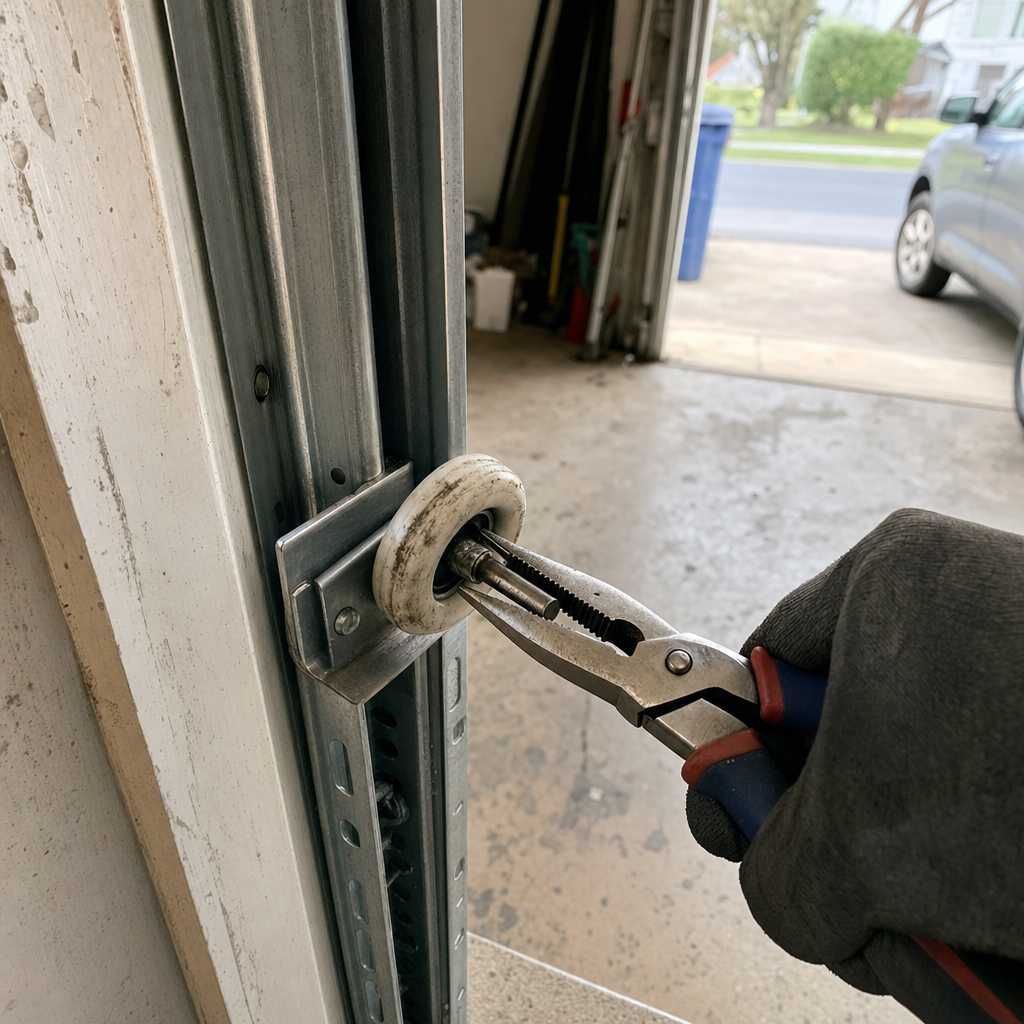
Use a socket wrench to snug anything loose—don’t overtighten, which strips threads in thin-gauge steel. Focus especially on the bottom roller bracket on each side; it carries the most dynamic load and is the most common point of catastrophic failure we see.
3. Track Alignment Visual
Stand inside the garage with the door closed. The vertical tracks should be perfectly plumb, and the horizontal tracks should tilt slightly down toward the back of the garage. Look for dents, gaps between rollers and track, or signs the door has been rubbing. Allentown’s freeze-thaw cycles heave garage floors and shift framing; tracks that were true in October may be binding by March.
4. Opener Safety Reversal
Place a 2×4 flat on the floor centered under the door path. Close the door with the remote. It must reverse within two seconds of contact. If it doesn’t, the force setting is too high—a liability issue and a code violation. Test the photoelectric eyes monthly too: wave a broomstick through the beam while the door is closing. It should reverse immediately.
Seasonal Maintenance: What Allentown’s Freeze-Thaw Cycles Demand
Allentown sits at the junction of two hardiness zones with real winter: twenty to thirty freeze-thaw cycles annually, humidity swings from summer highs near 80% to winter indoor dryness below 30%, and road salt that finds its way into every garage. These conditions accelerate specific failure modes.
Spring (March–April): Post-Winter Assessment
- Inspect spring coils for rust pitting. Surface rust is cosmetic; pitting that you can catch with a fingernail means metal fatigue is advancing. In our experience, springs that show pitting in March fail 70% of the time by the following winter.
- Check weatherstripping. The rubber bottom seal hardens and cracks after cold exposure. A compromised seal lets water, salt, and rodents in—rodent damage to wiring is a top-five spring repair call we get in South Allentown.
- Test the manual release. After months of disuse, the red cord mechanism can stiffen. Verify it disengages smoothly; if you ever need it in an emergency, it needs to work.
Fall (October–November): Pre-Winter Prep
- Lubricate before the cold sets in. Silicone spray maintains viscosity down to about 0°F; lithium grease handles colder but attracts grit. We use silicone on most Allentown installations unless the garage is unheated and exposed.
- Verify heater or vent clearances. If you’ve added a garage heater, confirm it’s not blowing directly on the opener logic board or safety sensors—thermal cycling kills electronics.
- Clear drainage. Allentown’s older neighborhoods often have garage slabs that settle toward the door. Make sure water runs away, not toward, the door and frame.
What a Professional Annual Tune-Up Actually Covers
A proper tune-up goes far beyond what a homeowner can or should attempt. Here’s what we perform on every annual service at Cardinal Garage Door Service Greater Allentown, and what you should verify any technician does:
| Component | What We Check | Pass/Fail Threshold |
|---|---|---|
| Torsion springs | Tension balance, coil gap consistency, anchor bracket integrity | Gap variation under ¼ inch; no coil binding at rest |
| Cables | Fray count, drum seating, pulley wear | Zero broken strands; drum shows no “birdcaging” |
| Rollers | Bearing play, stem wear, track fit | No wobble or grinding; nylon rollers show no flat spots |
| Opener force settings | Down-force and up-force calibration | Door reverses on 2×4 test; no hesitation at mid-travel |
| Safety sensors | Alignment, response time, wiring integrity | Beam interruption causes reversal in under 1 second |
| Weatherstripping | Flexibility, seal contact, fasteners | No daylight visible at any point when door is closed |
Stephen Rogers performs this inspection personally on every tune-up we book. After fourteen years, the pattern recognition is immediate: a Wayne Dalton TorqueMaster spring tube with a specific click on manual lift means internal failure within six months; a Clopay wind-load door with track spread at the top section means the horizontal reinforcement is fatiguing. That expertise—knowing what “almost broken” sounds like—is what separates a specialist from someone running down a checklist they learned last month.
The Lubrication Guide: Right Product, Right Component, Right Interval
This is where well-meaning homeowners cause the most damage. The wrong product attracts grit, gums up in cold weather, or degrades plastic and nylon components.
What to Use Where
- Torsion springs and extension springs: Silicone-based spray lubricant (white lithium grease alternative in very cold garages). Apply a light film across the coil surface. The goal is reducing friction between coils, not soaking the spring.
- Hinges and rollers (metal-to-metal): Same silicone spray. Hit the hinge pin and roller stem where it passes through the bracket. Wipe excess; pooled lubricant collects Allentown’s road dust all summer.
- Roller bearings (nylon or steel): If sealed, no lubrication needed. If open-bearing steel rollers, light machine oil on the bearing race only—never the wheel surface that contacts track.
- Track interior: Nothing. Clean with a rag if needed. Lubricated tracks cause rollers to slip, not roll, creating flat spots and binding.
- Opener chain or screw drive: Manufacturer-specific grease per the manual. Most modern Chamberlain and LiftMaster units are maintenance-free on the drive mechanism.
The WD-40 Problem
WD-40 is a solvent and water displacer, not a lubricant. It evaporates within days, leaving a sticky residue that attracts abrasive grit. We’ve replaced rollers and hinges in Allentown homes where WD-40 was used monthly for years—the accumulated gunk had literally ground away the bearing surfaces. If it’s in your garage for door maintenance, move it to the shelf with the rust removers where it belongs.
Apply lubricant every three months for doors used daily; every six months for occasional use. Do it in fall before cold weather and spring after the salt season.
How to Inspect Springs and Cables Without Getting Hurt
This section carries a safety duty of care: garage door springs are under extreme tension and can cause severe injury or death if handled improperly. These instructions are for visual and auditory inspection only—never attempt to adjust, wind, or replace springs yourself.
Torsion Spring Visual Inspection (Do Not Touch)
Stand to the side of the spring tube, never directly in front. With the door closed, examine the coil gap—the space between each winding of the spring. It should be consistent along the entire length. Look for:
- Coil gap variation: A section where coils are tighter or looser than the rest indicates metal fatigue and imminent failure
- Rust pitting: Small craters you can catch with a fingernail, not surface discoloration
- Coil deformation: Any section that looks stretched, kinked, or no longer perfectly cylindrical
- End cone cracks: The cast fittings at each end of the spring; stress fractures propagate fast
In Allentown’s humidity, especially in unventilated garages near the Lehigh River, we see accelerated rust pitting on springs that should have years of life left. A spring that looks merely “surface rusty” in September can be pitted through by March.
Cable and Drum Inspection
With the door fully closed, trace the lift cables from the bottom bracket up to the drum at each end of the spring tube. You’re looking for:
- Broken strands: Even one broken wire in a 7×19 cable means replacement time. Frayed sections “birdcage” outward as internal strands break first.
- Drum groove wear: The cable should seat cleanly in the groove. A polished or worn groove allows cable stacking and uneven lift.
- Bottom bracket integrity: The bracket where the cable attaches carries enormous load. Any crack, elongation, or corrosion here is an immediate call-a-pro situation.
This cable-drum inspection catches roughly eighty percent of the imminent failures we see before they strand a car. The other twenty percent are sudden—manufacturing defects, impact damage—but the visible wear is your reliable early warning.
The Sound Test
Open and close the door manually (opener disconnected). A healthy system is nearly silent beyond roller rumble. Grinding, popping, or a rhythmic “thunk” each revolution of the spring means something is binding, worn, or misaligned. Note the exact point in the travel where the sound occurs—that’s diagnostic gold for the technician.
Opener Safety Systems: Testing What Protects Your Family
Every automatic opener manufactured since 1993 must have two independent safety systems: mechanical reversal on contact and photoelectric eyes. Both can drift out of calibration, and both are legally required to function.
Force Setting Verification
The down-force setting controls how hard the door pushes before reversing. Too high, and it crushes what it hits; too low, and it reverses on normal friction, refusing to close. Test monthly with the 2×4 on the floor method described earlier. If your opener lacks force adjustment screws (many newer LiftMaster and Chamberlain units are electronically controlled), the limit and force settings require professional programming tools.
Photoelectric Eye Alignment and Function
The two sensors mount four to six inches off the floor on either side of the door. One emits an invisible beam; the other receives it. When misaligned, the LED indicator changes from steady to blinking. Clean lenses with a soft cloth—Allentown’s pollen season and winter road film coat them quickly. Verify response by interrupting the beam during closure; reversal should be instantaneous. If there’s any delay, the wiring or logic board needs attention.
Wall Button and Remote Function
The hardwired wall button must be the only control that closes the door without safety system engagement—this is a UL 325 requirement. Test that remotes and keypads won’t override a blocked sensor. If they do, the opener installation is non-compliant and potentially hazardous.
Common Mistakes to Avoid
- Using WD-40 as a lubricant. We’ve addressed this, but it bears repeating: we’ve replaced prematurely failed components in Trexler Park and Dorneyville homes where this single mistake cost $200–$400 in avoidable repairs.
- Overtightening hardware. Strip a thread in a thin-gauge hinge or bracket, and you’re now replacing the component instead of tightening it. Snug is sufficient; gorilla strength is destructive.
- Ignoring a slow door. A door that takes noticeably longer to open is telling you the opener is compensating for spring fatigue or track binding. The opener will fail next, and it’s the more expensive component.
- DIY spring “adjustment.” No YouTube video changes the physics. Torsion springs store lethal energy. In fourteen years, we’ve seen two serious homeowner injuries from attempted spring work in the Allentown area. The savings aren’t worth the risk.
- Neglecting the emergency release. If your power is out and your car is inside, a stuck release mechanism turns inconvenience into crisis. Test it quarterly.
- Assuming a quiet door is a healthy door. Some failures are silent until catastrophic. Cable corrosion inside the drum, spring fatigue in the early stages, and track misalignment can all progress without audible warning. Visual inspection matters.
When to Call a Professional
Some findings demand immediate professional attention—waiting converts a repair into an emergency. Call Garage Door Repair in Allentown if you observe: any broken strand in a lift cable; coil gap variation or visible deformation in a torsion spring; a door that won’t stay open at any position or slams closed; opener reversal failure on the 2×4 test; grinding or popping sounds you can’t locate; or any hardware component that’s cracked, elongated, or no longer securely fastened.
Cardinal Garage Door Service Greater Allentown offers Garage Door Repair services with free estimates in Allentown—call (877) 730-7790. Stephen Rogers handles the diagnostic personally, and if the situation is urgent, we prioritize same-day response. When your door is stuck open overnight or won’t secure before a trip, that can’t wait.
Frequently Asked Questions
A professional annual tune-up in the Allentown market typically runs $89–$149 depending on door size, spring type, and whether opener programming adjustments are needed. The inspection itself takes 45–60 minutes and includes all the pass/fail checks outlined in our table above. Call (877) 730-7790 for an exact quote on your specific door—estimates are free.
Homeowners can safely lubricate hinges, roller stems, and spring coils with the correct silicone-based product. Leave opener chain/screw lubrication, track adjustment, and any component that requires disassembly to a technician. The most common mistake we correct is over-application—more lubricant is not better. If you’re unsure whether your product is appropriate, snap a photo of the label and text it to us before applying.
Standard torsion springs are rated for 10,000 cycles (roughly 7–10 years of typical use). In Allentown’s climate, rust pitting can shorten this significantly— we’ve replaced springs after 4–5 years in unventilated garages near the river. High-cycle springs (25,000–50,000 cycles) last longer but cost more upfront. The annual professional inspection is what tells you whether your specific springs are on track for their rated life or failing early.
The bang is typically a torsion spring releasing stored energy unevenly due to binding—often from congealed lubricant, contracted metal components, or ice in the track. In Allentown’s January cold snaps, we see this frequently in garages that aren’t heated. Don’t ignore it: the spring is telling you it’s fighting itself, and each bang is stress that shortens its life. A Seasonal Garage Door Care for Allentown: Year-Round Homeowner’s Guide approach with cold-rated silicone spray often resolves it; persistent banging needs professional assessment.
Repair makes sense for units under 8–10 years old with isolated failures—bad capacitor, stripped gear, misaligned sensor. Replacement is more economical when the unit is older, the brand is obsolete (parts unavailable), or you’re facing multiple concurrent failures. A new Chamberlain or LiftMaster belt-drive opener with battery backup and smart connectivity runs $350–$550 installed in Allentown. We’ll always tell you honestly which path saves money over the door’s remaining life.
Spring failure that damages the door itself. When a torsion spring breaks violently, it can whip into the top section of a Clopay or Amarr door, creasing or splitting the panel. Now you’re replacing a $2,000–$3,500 door instead of a $180–$340 spring. The warning signs—coil gap changes, increased opener strain, slight door sag when open—are visible months in advance to someone who knows what to look for.
The Bottom Line
Garage door maintenance isn’t complicated, but it is specific. The ten-minute monthly checks, the seasonal lubrication with the right product, and the annual professional inspection form a system that prevents the failures we respond to every week in Allentown. The pattern is consistent: homeowners who learn what worn looks like before it breaks spend a fraction of what reactive repair costs, and they never face the 6 a.m. surprise of a door that won’t open for work. For How to Hire a Garage Door Contractor in Allentown: A Step-by-Step Guide and everything beyond visual inspection and basic lubrication, there’s real hazard in DIY—and real value in having the person who shows up be the same person who owns the business and stands behind the work.
Ready to schedule your annual inspection or need a professional assessment of something you’ve found? Cardinal Garage Door Service Greater Allentown serves homeowners across Allentown with the same direct accountability on every call. Contact us at (877) 730-7790 for a free estimate, or explore Garage Door Installation in Allentown and Garage Door Opener in Allentown if your system is approaching replacement age.
Written by Stephen Rogers, Owner & Lead Technician at Cardinal Garage Door Service Greater Allentown, serving Allentown since 2012.