
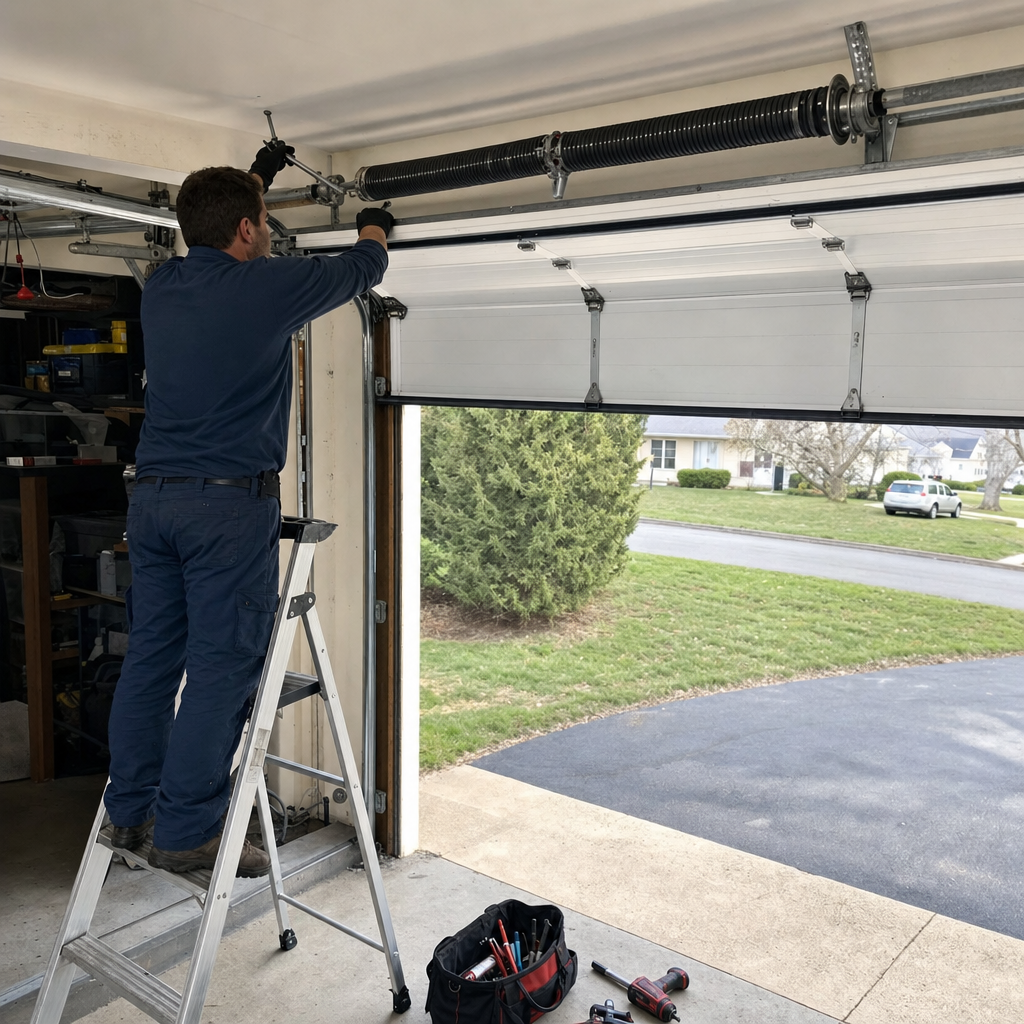
Last updated July 15, 2026
Seasonal Garage Door Care for Allentown: Year-Round Homeowner’s Guide
The busiest week of my year isn’t random — it’s the first hard freeze after a wet fall, when every door that wasn’t prepped for winter decides to make that known at 7 a.m. In 14 years of working on garage doors across Allentown, I’ve learned that Lehigh Valley weather doesn’t just wear your door down gradually; it attacks in predictable seasonal waves. Most homeowners in Allentown only call when something breaks, but the damage that triggers that emergency call started weeks earlier — usually during a season transition they didn’t think to prepare for. This guide maps exactly what to do and when, based on how Allentown’s actual climate patterns stress garage door systems differently in each season — a companion to The Complete Guide to Garage Door in Allentown.
Quick Answer
Seasonal garage door maintenance in Allentown means four distinct prep routines timed to Lehigh Valley weather: seal and sensor checks before the first freeze (late October), spring tension and lubrication inspection before peak cold (December), post-winter track and weatherstrip assessment (March), and summer humidity protection for wood doors (June). Done on this schedule, most emergency repairs can be prevented entirely.
Table of Contents
- Fall Prep: The Critical Window Before Allentown’s First Freeze
- Winter Failure Patterns: Why Springs Snap in January and February
- Spring Recovery: What Freeze-Thaw Does to Your Door
- Summer Neglect: Heat and Humidity Most Homeowners Ignore
- Month-by-Month Maintenance Calendar for Allentown
- What You Can Check Yourself vs. What Needs Stephen Rogers
- Common Mistakes to Avoid
- When to Call a Professional
- Frequently Asked Questions
- The Bottom Line
Fall Prep: The Critical Window Before Allentown’s First Freeze
In Allentown, the first hard freeze typically lands between October 20 and November 10, and that date range matters more than most homeowners realize. Every fall, we see the same pattern: a wet October with rain and leaf debris, followed by a sudden temperature drop that turns that moisture into frozen seals, seized rollers, and misaligned safety sensors.
The bottom seal on your garage door is where fall prep pays off most in Allentown’s climate. Unlike warmer regions where seals just keep out dust, here they face a freeze-thaw cycle that can bond rubber to concrete. When that happens and the opener tries to pull the door, you’re looking at stripped gears on a LiftMaster or Chamberlain unit, or a burned-out motor. Here’s what we do on every fall service call in the West End, East Side, and South Allentown neighborhoods:
- Remove and inspect the bottom seal — look for cracking, flattening, or hardening. A seal that sat in summer heat is already compromised before winter stress begins.
- Clean the seal channel and door bottom — leaf tannins and road salt residue from the previous winter accelerate rubber deterioration.
- Test the auto-reverse with a 2×4 — cold affects photo-eye alignment; verify it now while temperatures are moderate and adjustments are easier to dial in.
- Lubricate rollers, hinges, and the torsion spring with silicone-based lubricant — not WD-40, which attracts debris and gums up in cold.
- Inspect weatherstripping on the door frame — gaps here let in the damp air that causes the freeze-bond problem in the first place.
In the Lehigh Valley, we also see a specific issue with Genie screw-drive openers in fall: the lubricant on the screw rail thickens as temperatures drop, causing the door to hesitate or reverse falsely. If you’ve got a Genie unit, fall is when we check and refresh that rail lubricant — it’s a five-minute job that prevents a midwinter service call.
The other fall-specific factor in Allentown is deer season and rural debris. Homes near Trexler Park or along the outskirts get more leaf litter, acorns, and even field mice seeking winter shelter. That debris packs into track bottoms and photo-eye housings. We clear it out now, not after it’s frozen solid.
Winter Failure Patterns: Why Springs Snap in January and February
Garage door torsion springs are steel under enormous tension, and steel gets brittle when cold. In Allentown, January nights routinely hit single digits, and every degree below 20°F increases the risk of a spring fracture. We’ve replaced more broken springs in the third week of January than any other week of the year — it’s that predictable.
Here’s the physics: your springs are rated for approximately 10,000 cycles at standard temperature. But cold contraction increases the effective stress per cycle, and if the spring was already near its fatigue limit from summer use, that first brutal cold snap finishes it. The spring doesn’t warn you; it just breaks, usually when the door is in motion, and the resulting bang sounds like a gunshot.
What you can do before temperatures drop:
- Listen for a creaking or pinging sound when the door operates — that’s the spring coils binding, often from inadequate lubrication.
- Check for a gap in the torsion spring coils when the door is closed — a visible separation means the spring has already lost tension and is working the opener harder.
- Feel if the door seems heavier to lift manually — springs losing strength overload the motor on your Chamberlain or Craftsman opener.
Critical safety note: Torsion springs are under lethal tension. Never attempt to adjust, wind, or replace them yourself. The stored energy can cause serious injury or death. If you suspect spring fatigue, that’s when Stephen shows up himself — it’s not a handyman job, and it’s not a YouTube tutorial situation.
Another winter-specific issue in Allentown: snowmelt and road salt. The city and PennDOT use salt and calcium chloride aggressively on Hamilton Boulevard, Tilghman Street, and the major routes. That slush gets tracked into garages, splashes onto door bottoms, and corrodes hardware. We see hinge pins and bottom brackets rust through by late February on doors that weren’t rinsed periodically. A simple floor squeegee and occasional hardware wipe-down prevents this, but most homeowners don’t think of it until the bracket cracks.
Finally, winter is when opener battery backups prove their worth — or don’t. Power outages during ice storms are common in the Lehigh Valley. If your opener lacks battery backup (standard on newer LiftMaster models, optional on some others), you’re manually lifting a heavy door in cold, dark conditions. We check backup function as part of winter prep.
Spring Recovery: What Freeze-Thaw Does to Your Door
March in Allentown is deceptive. Days hit 50°F, snow melts, homeowners think winter’s over. But night temperatures still dip below freezing, and that daily freeze-thaw cycle is brutal on garage door components that spent three months contracted and cold.
The most common spring call we get isn’t about the spring — it’s about the door hitting the ground hard, or reversing unexpectedly, or making a grinding noise it didn’t make in February. What’s happened is the freeze-thaw has shifted things:
- Track alignment — the metal track expanded and contracted all winter, and mounting brackets loosen. By March, the track has subtle bends or shifts that cause rollers to bind.
- Weatherstrip hardening — rubber that froze repeatedly is now cracked and no longer seals. Wind-driven spring rain in Allentown gets past it, and by April you’re seeing water staining on the garage ceiling below the door header.
- Panel seam separation on steel doors — Clopay and Amarr steel doors have interlocking panel edges. The thermal movement of winter can separate these slightly, creating gaps that whistle in wind and let in moisture.
- Opener force settings — the opener was adjusted for winter, when the door moved stiffly. Now it’s moving freely, but the force setting is still cranked high, which means the door slams closed and stresses the entire system.
Our March inspection protocol for Allentown homes includes re-torquing all track mounting hardware, replacing weatherstrip that’s lost elasticity, checking panel alignment on steel doors, and recalibrating opener down-force and limit settings. It’s also when we inspect cables for fraying — winter cold makes cable strands brittle, and spring is when the accumulated fatigue shows as broken wires.
For homes in older Allentown neighborhoods like the Historic District, where garages may be detached and unheated, we pay special attention to wood door panels. A Raynor or Clopay wood door that absorbed moisture through compromised finish over winter will show swelling, delamination, or rot by March. Caught early, it’s a panel repair; caught late, it’s full door replacement.
Summer Neglect: Heat and Humidity Most Homeowners Ignore
Summer is the forgotten season for garage door maintenance in Allentown, and that’s a mistake. July and August average 83°F highs with humidity pushing 70% — conditions that stress components differently than winter cold but just as seriously.
Wood door expansion is the big one. A solid wood or wood-composite door in a south-facing Allentown garage can absorb enough moisture to expand 1/4 inch or more across its width. That binds it in the tracks, overloads the opener, and can warp panels permanently. We see this especially in homes near the Lehigh River and Jordan Creek, where humidity lingers. The fix is preventive: inspect the door’s finish in late June, touch up any bare spots, and ensure the top and bottom edges are sealed — the areas factory finish often misses.
Lubrication viscosity changes in heat. The silicone lubricant we applied in fall is now thinning and dripping onto cars and garage floors. Worse, it’s no longer protecting metal-on-metal contact points. Summer is when we refresh lubrication with a heavier garage-door-specific formula that stays put.
Opener electronics suffer in heat. The logic board in your Genie or LiftMaster unit is sensitive to sustained temperatures above 120°F, which an unventilated Allentown garage easily reaches in August. Symptoms are erratic operation — door stops mid-travel, remote works intermittently, wall button flashes codes that don’t match the manual. We check for proper ventilation, shade the opener if possible, and verify the motor isn’t cycling on thermal overload.
Photo-eye misalignment from floor heave — summer drought followed by sudden storms can shift garage slabs, especially in the clay-heavy soils of Lower Macungie and the surrounding townships we serve from Allentown. A shifted slab tilts the photo-eye brackets, breaking the beam and causing false reversals.
The other summer-specific issue: storms and power surges. Allentown gets severe thunderstorms July through September, and a lightning strike on the grid can fry opener circuit boards. A surge protector on the opener outlet is cheap insurance; we install them on request, or you can use a quality residential unit.
Month-by-Month Maintenance Calendar for Allentown
Here’s the schedule we use ourselves, tied to Allentown’s actual average climate data from the National Weather Service (Lehigh Valley International Airport station):
| Month | Avg. High/Low | Key Task | What We’re Preventing |
|---|---|---|---|
| September | 76°F / 55°F | Full system inspection; order parts if needed | October rush; parts delays |
| October | 64°F / 43°F | Seal replacement; sensor alignment; lubrication | Freeze-bond failures |
| November | 52°F / 33°F | Final hardware torque check; opener force verify | First-hard-freeze surprises |
| December | 41°F / 25°F | Spring tension assessment; cable inspection | Midwinter spring breaks |
| January | 36°F / 20°F | Monitor for unusual sounds; clear salt/debris | Cumulative corrosion damage |
| February | 40°F / 22°F | Check weatherstrip integrity after coldest period | Air infiltration; water damage |
| March | 50°F / 30°F | Post-winter alignment; force recalibration; strip replace | Freeze-thaw binding; slamming |
| April | 62°F / 39°F | Wood door finish inspection; touch-up | Moisture absorption; rot |
| May | 72°F / 49°F | Full hardware re-torque after thermal cycling | Loose bracket failures |
| June | 81°F / 59°F | Humidity prep; ventilation check; lubrication refresh | Wood swelling; opener overheating |
| July | 85°F / 64°F | Surge protector verify; photo-eye slab check | Lightning damage; false reversals |
| August | 83°F / 62°F | Opener thermal performance check | Logic board failure |
This calendar assumes a typical steel or wood residential door with standard extension or torsion spring system. If you’re running a heavy Clopay insulated door or a high-cycle commercial setup in a South Allentown workshop, the intervals compress — call for a custom schedule.
What You Can Check Yourself vs. What Needs Stephen Rogers
We’re straightforward about this: some maintenance is homeowner-friendly, some isn’t, and the line is drawn at safety risk and specialized tools.
Safe for most homeowners:
- Visual inspection of springs, cables, rollers, and hinges — look for rust, fraying, cracking, or gaps
- Photo-eye cleaning with a soft cloth — no adjustment, just lens wiping
- Auto-reverse testing with a solid object (not your hand or foot)
- Listening for unusual sounds during operation — grinding, squealing, popping
- Checking door balance by disconnecting the opener and lifting manually — should move smoothly and stay at half-open
- Weatherstrip visual check for cracks or compression
Leave to Cardinal Garage Door Service Greater Allentown:
- Any torsion spring work — winding, unwinding, replacement
- Cable replacement or adjustment — stored energy risk
- Track realignment or bending repair — precision-critical
- Opener logic board diagnostics and replacement
- Spring tension adjustment on extension spring systems
- Bottom bracket replacement — these are under cable tension
We’ve seen too many injuries from homeowners who watched a video and thought they understood torsion spring physics. Stephen shows up himself for these calls because they’re not delegate-able — the person assessing the risk needs to be the one accountable for the fix.
Common Mistakes to Avoid
- Using WD-40 on garage door components — it’s a solvent, not a lubricant, and attracts grit that accelerates wear. We’ve replaced rollers that were “lubricated” weekly and destroyed within a year.
- Ignoring the door until it won’t open — in Allentown’s climate, the warning signs (noise, hesitation, sag) appear 2-4 weeks before failure. That window is your chance to prevent the emergency.
- Adjusting opener force settings without checking door balance first — if the door is heavy from spring fatigue, cranking the opener force masks the problem until the motor burns out. We see this on Craftsman and Raynor openers especially.
- Replacing the opener when the real problem is the door — a new LiftMaster on a binding, unbalanced door will fail the same way the old one did. We diagnose the full system, not just the symptom.
- Skipping summer maintenance entirely — Allentown homeowners focus on winter prep and ignore July and August, then wonder why their wood door is warped or their opener board failed.
- Hiring a general handyman for spring or cable work — we’ve been called to fix the aftermath. Garage door springs are a specialty; 14 years, one specialty means we’ve seen the failure modes a generalist hasn’t.
- Not testing the auto-reverse after any adjustment — whether you bumped the photo-eye or we replaced a component, verify the safety function. It’s not just about protection; federal law requires it, and liability follows if someone is injured.
When to Call a Professional
Call when you hear a new noise, see a new movement, or smell something hot from the opener — these are the three senses that catch problems before they become emergencies. Specifically: a broken spring (door won’t lift, or lifts with visible gap in spring), a door off its tracks, a cable that has come loose or frayed, an opener that hums but doesn’t move the door, or any situation where the auto-reverse doesn’t function.
For Allentown homeowners, we also recommend a professional inspection if your door is more than 10 years old and has never had one, if you’re buying a home and the garage door history is unknown, or if you’ve had two or more repairs in the past 12 months — that’s a pattern indicating systemic wear.
Garage Door Repair in Allentown from Cardinal Garage Door Service Greater Allentown offers free estimates — call (877) 730-7790. Stephen Rogers handles the assessment personally, and if we can solve it with advice over the phone, we’ll do that first.
Frequently Asked Questions
A professional seasonal tune-up in Allentown typically runs $89–$149, depending on door size, spring type, and whether parts need replacement. Full inspections that include spring tension testing, track alignment, opener force calibration, and hardware torque verification fall in this range. Call (877) 730-7790 for an exact quote — estimates are free, and we’ll tell you if your door actually needs service or just some homeowner-level attention. For related guidance, see Garage Door Permits, Codes & Inspections in PA: What You Need to Know.
You can handle visual inspections, cleaning, lubrication, and safety testing, but torsion spring work, cable service, and track realignment require specialized tools and training. In 14 years, we’ve seen serious injuries from homeowners attempting spring replacement after watching online tutorials. The safe rule: if it stores energy, call Stephen Rogers.
Cold makes steel brittle and increases the stress per cycle. Allentown’s January temperatures routinely drop below 20°F, and springs already near their fatigue limit from normal use fracture under the added thermal stress. Pre-winter inspection and lubrication reduce but don’t eliminate this risk — it’s physics, not neglect.
Twice yearly: before the first freeze (October) and before peak summer humidity (June). Use silicone-based garage door lubricant, not WD-40. In Allentown’s freeze-thaw climate, the October application protects through winter; the June refresh handles summer heat and humidity that thin out the previous coating.
If you’re calling for repairs more than twice a year, replacement usually wins on total cost within 2-3 years. A new Clopay or Amarr steel door with modern hardware and a properly matched opener eliminates the accumulated wear that’s causing repeat failures. We assess this honestly — 619 neighbors have trusted us because we don’t sell replacement when repair makes sense.
Yes — emergency garage door service is available for situations where the door is stuck open, stuck closed, or compromised in a way that affects home security. We prioritize calls from Allentown and the immediate Lehigh Valley, and Stephen shows up himself for emergencies. Call (877) 730-7790; if it’s after hours, leave a message and we’ll return it promptly.
The Bottom Line
Allentown’s four distinct seasons create four distinct garage door failure modes, and the homeowners who avoid emergencies are the ones who match maintenance to the transition, not the breakdown. Fall seal prep prevents winter freeze-bond disasters. Pre-winter spring assessment reduces January fractures. Post-winter alignment fixes catches freeze-thaw damage before it compounds. Summer humidity management protects wood doors and opener electronics that most homeowners forget about entirely. The work isn’t complicated, but the timing is everything — and when the job requires more than a visual check, Cardinal Garage Door Service Greater Allentown home is where 619 of your neighbors have turned for straightforward, owner-delivered expertise.
Ready to get ahead of the season? Call (877) 730-7790 for a free estimate. Stephen Rogers will assess your door personally, tell you exactly what it needs and what it doesn’t, and get the work done before the weather turns.
Written by Stephen Rogers, Owner & Lead Technician at Cardinal Garage Door Service Greater Allentown, serving Allentown since 2012.